Skin education
Skin boosters vs moisturiser: which one does your dry skin actually need?
A straight-talking guide to what each one does, what the evidence says, and when your skin might benefit from either.
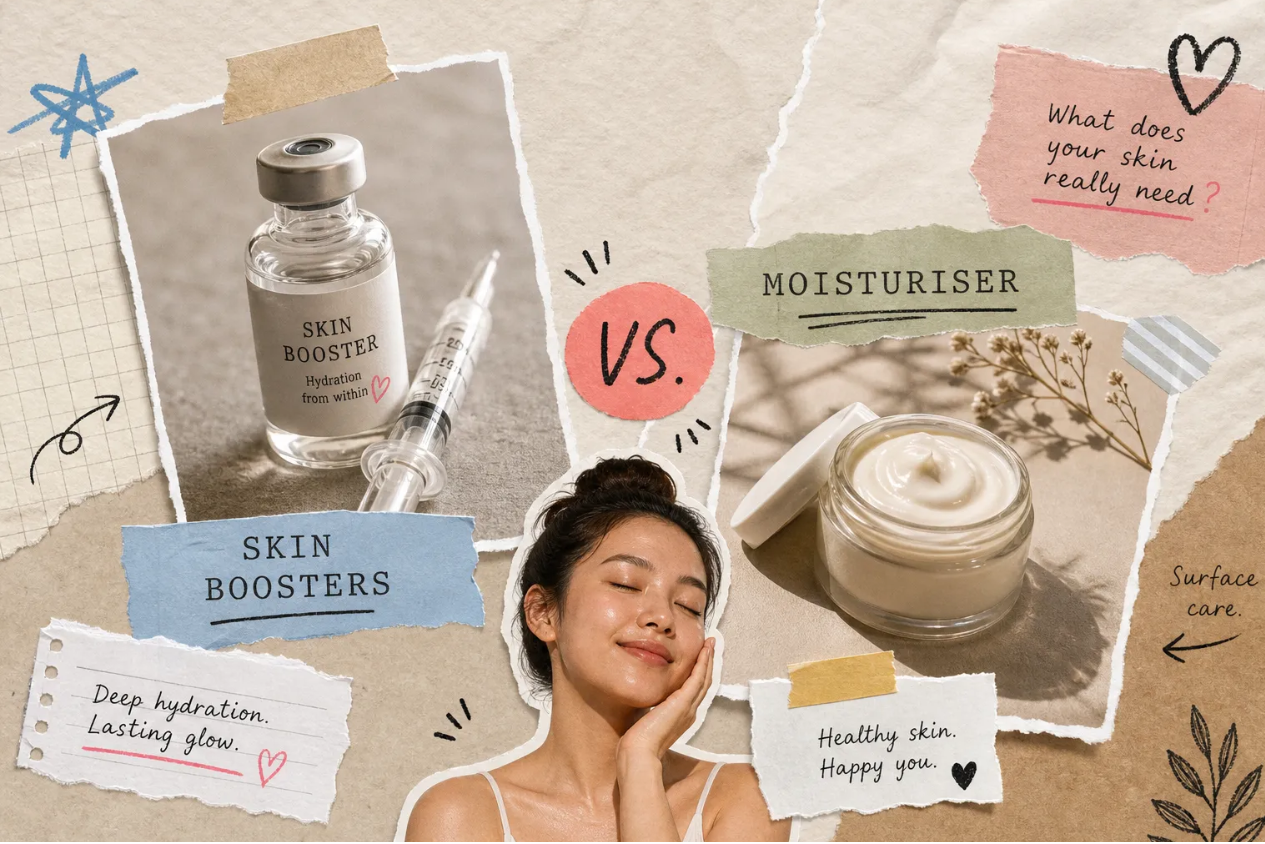
Let's clear something up straight away: skin boosters and moisturiser aren't rivals. They're not even playing the same sport.
Your moisturiser works on the very top layer of your skin. Skin boosters put hyaluronic acid into the dermis, the deeper layer where your collagen and elastin live. Same goal—happy, hydrated skin—but a completely different postcode.
Here's the honest bit, from a clinic that does offer skin boosters: for most people with dry skin, a really good moisturiser is still the right place to start. Boosters come in when your skincare is doing everything right and your skin still looks thirsty, crepey or a bit “meh”.
Grab a cuppa. Here's how each one works, what the evidence actually says, and how to tell which your skin might need.
What a good moisturiser actually does
A proper moisturiser has three jobs. Most products on the shelf only bother with one or two.
- Draw water in. Humectants like glycerin and urea pull water into the top layer of your skin.
- Keep it there. Occlusives like petrolatum, dimethicone or paraffin form a light seal so that water doesn't just wander off.
- Fix the leaks. Ceramides, cholesterol and fatty acids repair your skin barrier, which is where the water escapes in the first place.
The best formulas do all three. Pro tip: put it on straight after your shower while your skin's still a bit damp. It genuinely works better.
The hyaluronic acid serum plot twist
This is the big one. Hyaluronic acid in a serum is not the same as hyaluronic acid in a skin booster. They just share a name, like two people called Dave.
Topical HA sits on or near the surface and holds water there. It doesn't get down into the dermis, whatever the bottle says. If you've been layering HA serum and wondering why your skin still feels tight, that's why.
What skin boosters actually do
Skin boosters use tiny injections to place stabilised hyaluronic acid into the mid-dermis. Once it's there, it holds water inside the skin itself, not just on top. That matters because dryness, loss of plumpness and crepey texture often start down in that deeper layer, where no cream can reach.
There are two main types:
- Traditional skin boosters, like Restylane Skinboosters, leave tiny deposits of HA across the area. Usually two to three sessions.
- Profhilo uses a high-concentration, ultra-pure HA that spreads through the tissue and also nudges your skin to make more collagen. Usually two sessions, four weeks apart.
And no, skin boosters aren't filler. Filler adds volume and shape. Boosters are all about hydration and skin quality. You'll look like you, just better rested.
So which works better?
Plot twist number two: nobody's properly tested them head to head. There are no solid trials putting skin boosters and a moisturiser against each other on the same people with the same measurements. Most booster studies compare skin before and after, not against a cream.
So anyone telling you boosters “beat” moisturiser is guessing. What we can say is that they work at different depths, for different lengths of time, on different problems.
Moisturiser
In one study, a 1% HA fluid boosted surface hydration by 59% after an hour, 48% after eight hours and 29% after 24 hours. Lovely, but it fades, so you need to keep applying it every day.
Skin boosters
Once you've done the first course, results usually last six to twelve months. Some Restylane protocols report up to fifteen months. Profhilo tends to last around six months, sometimes closer to nine.
| Moisturiser | Skin boosters | |
|---|---|---|
| Where it works | Top layer of skin (outermost 10–20 µm) | Dermis (hundreds of micrometres down) |
| How often | Once or twice a day | 2–3 sessions, then a top-up every 4–6 months |
| How long it lasts | Hours per application | 6–12 months per course (up to 15 for some protocols) |
| Medical procedure? | No | Yes |
| Risks | Minimal; possible sensitivity to ingredients | Bruising, swelling and bumps are common; vascular complications are rare |
The not-so-glamorous bit: side effects
We'd rather you hear this from us than from a forum at 2am.
- Common: bruising, redness, swelling and small raised bumps where the injections went in. These usually settle within a few days.
- Less common: lumps that hang around (nodules), inflammation, and cold sores flaring up if you get them.
- Rare but serious: vascular occlusion, where product enters or presses on a blood vessel and can damage tissue. In very rare cases this has affected vision.
Skin boosters aren't for you right now if you:
- Are pregnant or breastfeeding.
- Have an active skin infection, including active acne or a cold sore.
- Have a bleeding disorder that isn't under control.
- Are allergic to any of the ingredients.
On blood thinners? Tell us before any injectable treatment.
So who's a good fit?
Team moisturiser
If your dryness is mild to moderate and your barrier's in decent shape, a moisturiser with glycerin, ceramides and an occlusive is your first move. It's cheaper, lower risk and you can stop any time. If your skin's happy with good skincare, it doesn't need injections, and we'll tell you to your face.
Team skin boosters
If you're doing all the right things with your skincare and your skin still looks dull, crepey or a bit deflated, that's when boosters may be worth discussing. The same goes if a clinician spots dehydration in deeper layers, or your skin has lost bounce and texture with age.
The goal is always the right treatment for what your skin actually needs, not upselling you for the sake of it.
Stop guessing, start scanning
Most of us buy moisturisers the way we pick wine: nice label, good reviews, fingers crossed. But your dryness could be a surface barrier issue, dehydration deeper down, or something else entirely, like eczema, a reaction to a product or a side effect of medication. Treat the wrong thing and you'll just get frustrated (and poorer).
At The Skin Edit Co, we use Observ skin analysis to see what's going on beneath the surface before we recommend anything: hydration, barrier health and structural concerns. For some people that means a tailored skincare routine. For others, a course of skin boosters. For lots of people, both.
No pressure, no hard sell. If the scan doesn't back it up, we won't recommend it.
The bottom line
Two tools for two layers.
Moisturiser is the foundation for everyone with dry skin. Skin boosters are for when the problem is deeper and your skincare has genuinely hit its limit. They're two tools for two layers, not a cage match.
Still not sure which camp you're in? Book a skin analysis with us in Ipswich and let your skin do the talking.
Book a skin analysisFrequently asked questions
How quickly will I see results from skin boosters?
You'll usually notice a difference once you've finished your first course, and it lasts for months: typically six to twelve, up to fifteen for some Restylane protocols, and around six (sometimes nearer nine) for Profhilo. Any bruising, redness or swelling usually settles within a few days.
How fast does moisturiser work, and how often do I need it?
Within hours, but it wears off, so it's a daily (or twice-daily) job. Apply it while your skin is still slightly damp after washing for the best results.
Can I have both?
Absolutely, and lots of clients do. Moisturiser does the daily surface work; boosters handle deeper hydration. A skin analysis can help work out whether you need one, the other or both.
Who shouldn't have skin boosters?
Skin boosters aren't suitable right now if you're pregnant or breastfeeding, have an active skin infection (including acne or cold sores), an uncontrolled bleeding disorder, or an allergy to any ingredient. If you take blood thinners, tell your clinician first. After treatment, get urgent medical help for severe pain, white or blotchy skin, or any change in your vision.