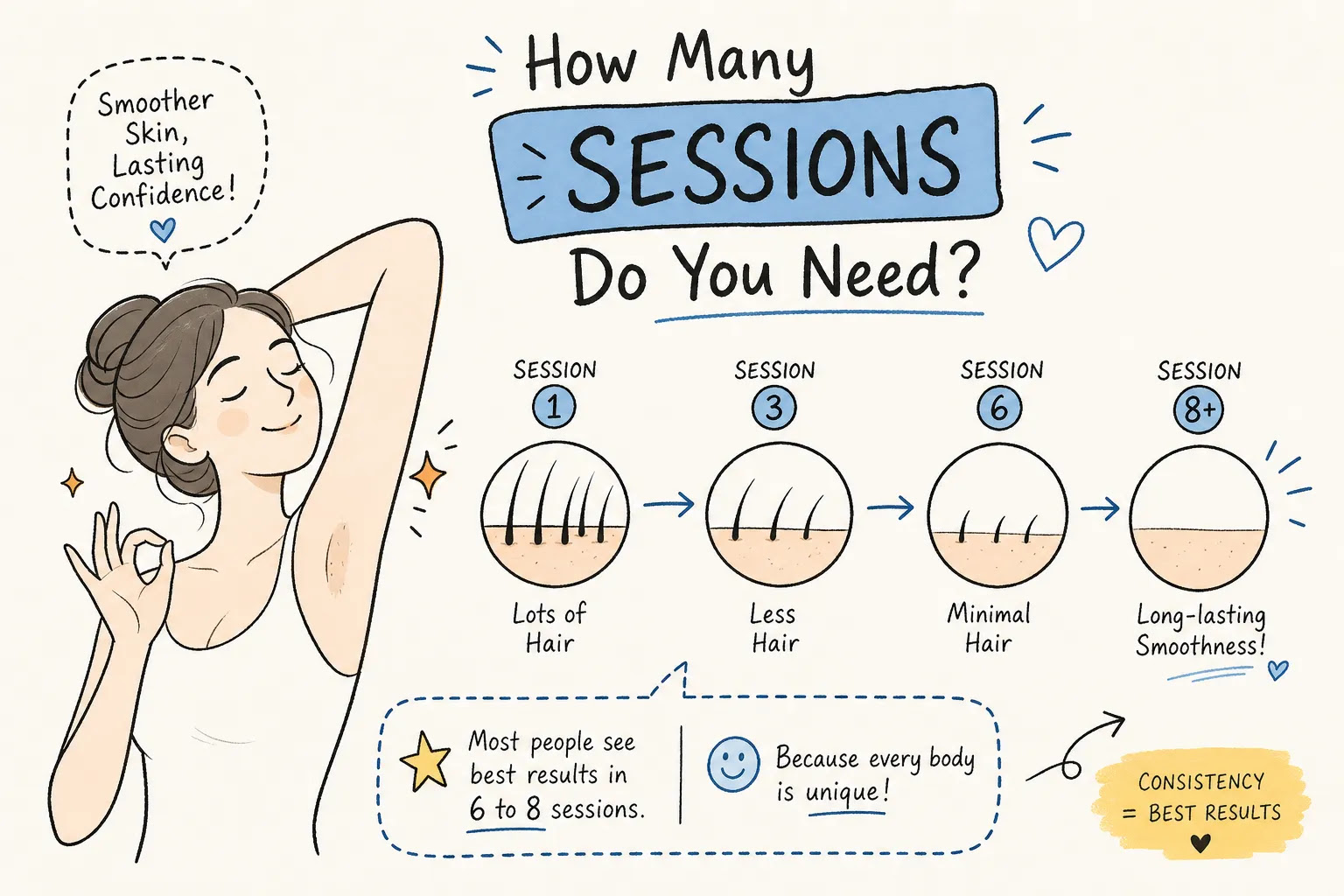
If you're wondering how many laser hair removal sessions you need in the UK, you won't find a single definitive number here. Not because we're being evasive, but because anyone who gives you a precise figure without first asking about your skin tone, hair colour, treatment area, and hormonal history is making an educated guess at best.
At The Skin Edit Co, this is the question that comes up in almost every first consultation, and the honest answer is always: it depends on you specifically.
What we can do is give you a realistic picture. By the time you've read this, you'll have a solid sense of the session range for your treatment area, a clear understanding of the factors that genuinely shift that number, and enough knowledge to ask the right questions before booking anywhere.
What "permanent hair reduction" actually means
Most people come in expecting to be hair-free forever after a set number of sessions. The reality is more layered than that, and being upfront about it is something we consider a baseline of good practice.
The correct term, widely used by UK practitioners and defined formally by the FDA, is permanent hair reduction, not permanent removal. It's worth noting that UK regulators such as the JCCP and CQC focus primarily on safety and service standards rather than adopting the FDA's wording verbatim, but the phrase is well established in clinical practice on both sides of the Atlantic. What it means in practice is a long-term, stable decrease in the number of hairs that regrow after a full treatment course. Electrolysis remains the only method classified as permanent removal — that's not a downside of laser; it's simply what the science says.
The reason multiple sessions are needed comes down to the hair growth cycle. Hair moves through three phases: anagen (active growth), catagen (transition), and telogen (resting). The laser only disables follicles in the anagen phase, because that's when the hair shaft contains enough melanin and is close enough to the follicle to conduct heat effectively. At any given time, only a proportion of your hairs are in that active phase. Each session catches a new batch of follicles at the right moment, which is why spacing and consistency matter just as much as the total number of appointments.
Typical session ranges by body area
The question we hear most often is: how many treatments will I actually need for my area? The honest range for most people is 6 to 10 sessions, but that spans a broad territory, so here's how it breaks down by area.
Face, upper lip, and underarms
Facial hair grows faster than body hair, which means the anagen phase cycles through more quickly. Upper lip and chin typically need 6 to 10 sessions, scheduled every 4 to 6 weeks to keep pace with that faster cycle. Underarms follow a similar pattern, with most clients completing their course in 6 to 8 sessions at 4 to 6 week intervals.
Many clients notice a meaningful reduction within the first three or four visits; the remaining sessions consolidate those results and catch the follicles that were resting earlier in the course.
Bikini, legs, and larger body areas
Bikini and VIO areas typically sit in the 6 to 10 session range as well, at 4 to 6 week intervals. Legs are a different case: the hair-growth cycle is slower, so sessions are usually spaced 6 to 8 weeks apart rather than 4 to 6. The total session count is similar, but the timeline stretches considerably.
A full leg course can realistically span 12 to 18 months once you factor in those longer intervals. This is worth knowing upfront, because clients who expect to be done in six months sometimes feel disappointed when the maths don't add up that way.
Typical Session Ranges at a Glance
How skin tone and hair colour shift the session count
The laser works by targeting melanin, the pigment found in the hair follicle. The greater the contrast between the hair colour and the surrounding skin tone, the more efficiently the laser can hit its target. This is why the combination of lighter skin with dark, coarse hair tends to respond fastest and often needs fewer sessions overall — the laser can work at higher fluence with less risk of affecting surrounding tissue, which means each session does more useful work.
Darker skin tones can absolutely be treated safely, but the settings need adjusting to protect the epidermis. This typically means lower fluence, longer pulse durations, and more aggressive cooling. That more cautious approach is entirely appropriate, but it can mean that each session removes a smaller percentage of follicles, leading to a slightly longer overall course. The right device matters here too, and we'll come to that in a moment.
Blonde, grey, white, and many red hairs present a different challenge entirely. These hair types contain very little melanin, which means the laser has almost nothing to target. Results in these cases are limited regardless of session count, and a good practitioner will tell you that honestly during a consultation rather than sell you a full course that won't deliver what you're expecting. Fine or sparse hair also responds more slowly than coarse, dense growth — again because there's simply less pigment per follicle.
Hormonal hair growth and PCOS: why standard estimates often fall short
This is one of the most searched but least clearly explained areas in laser hair removal. Many clients with PCOS have had disappointing results elsewhere — not because laser doesn't work for them, but because the clinic treated them like any other client and gave them a standard course without accounting for what's driving the growth.
Androgens, which are elevated in conditions like PCOS, continuously stimulate hair follicles, including ones that have already been treated. The laser does its job on the follicles it can access during each session, but the underlying hormonal environment can recruit new follicles into active growth after treatment. What looks like regrowth is often new follicle activation rather than treated follicles recovering. This distinction matters for how treatment is planned.
A study published in the Journal of Cosmetic and Laser Therapy found that after six sessions, women with PCOS typically showed around 31% hair count reduction on average, compared with significantly higher results in non-hormonal cases. That doesn't mean laser isn't worth pursuing — it means the plan needs to be different.
If You Have PCOS or a Hormonal Condition
Why the device used changes everything
A lot of consumer confusion around laser hair removal comes from the fact that not all devices are equal, and the term "laser" gets applied loosely in marketing. The most important distinction is between medical-grade lasers and IPL.
IPL, or intense pulsed light, is not a laser. It uses a broad spectrum of light rather than a focused wavelength, which makes it less precise and generally less efficient at targeting the follicle. IPL courses commonly require 6 to 10 or more sessions to achieve results comparable to a medical-grade laser device, and IPL is less reliable on darker skin tones because the lack of wavelength specificity increases the risk of affecting surrounding tissue.
Medical-grade laser systems — including diode, Alexandrite, and Nd:YAG devices — use specific wavelengths matched to the melanin target and adjusted for the client's skin type. Most clinical courses using these devices sit at 6 to 8 sessions rather than 10 or more. Choosing an appropriate medical-grade device with correct settings from session one can reduce the risk of needing extra corrective treatments and helps ensure you're not extending an already lengthy course unnecessarily.
The Candela Platform at The Skin Edit Co
We use the Candela laser platform — a medical-grade dual-wavelength system (Alexandrite 755nm and Nd:YAG 1064nm) that covers all Fitzpatrick skin types with built-in cooling and adjustable parameters. Each session is calibrated precisely for your skin and hair combination, rather than applying a one-size setting that underdelivers for some clients and risks harm for others.
Why a proper consultation gives you an accurate answer
The number of sessions you need is personal to you. A useful first consultation covers your Fitzpatrick skin type, hair colour and coarseness, the area being treated, any hormonal factors or relevant medications, and your previous hair removal history. At The Skin Edit Co, we also use the Observ skin analysis system as part of our clinic assessment process, which gives us a more detailed picture of the skin and helps inform how sessions are spaced and what parameters are appropriate from the very first appointment.
The issue with clinics that lead with packages is that a course sold before a proper assessment may be the wrong length, use the wrong device for your skin type, or fail to account for hormonal factors that will change how treatment progresses. A seven-session course sold to someone with PCOS and fine facial hair isn't a bargain — it's a course built without the information needed to structure it properly.
So, how many laser hair removal sessions do you need in the UK? For most people, somewhere between 6 and 10 — but your skin tone, hair type, treatment area, and hormonal profile all play a part in where you land within that range. The most useful first step before buying any package is a conversation with a qualified practitioner who can look at your specific situation and give you an honest, grounded estimate.
Frequently asked questions
How long between laser hair removal sessions?
Intervals depend on the treatment area. Face and underarm sessions are typically spaced every 4 to 6 weeks; legs and larger body areas are usually 6 to 8 weeks apart to align with the slower hair growth cycle in those areas.
Will I need maintenance sessions after my initial course?
Most clients with straightforward hormonal profiles find results remain stable after a full course, though occasional top-ups every 12 months or so can help. Clients with PCOS or other hormonal conditions are more likely to benefit from periodic maintenance, typically every 6 to 12 months.
Does skin tone affect how many sessions I need?
Yes. Lighter skin tones with dark, coarse hair generally respond most efficiently, as the laser can operate at higher fluence. Darker skin tones require adjusted settings to protect the epidermis, which can mean a slightly longer overall course. The right device — such as an Nd:YAG — is essential for safe and effective treatment across all skin tones.
Is laser hair removal different to IPL?
Yes, significantly. IPL uses a broad spectrum of light and is not a true laser. It is generally less precise, less efficient per session, and can require more treatments overall to achieve comparable results to a medical-grade laser system.
Based in Ipswich or Suffolk?
Get a Clear Picture of Your Treatment Plan
Book a consultation at The Skin Edit Co and we'll give you a straightforward answer based on what we actually see — not a number pulled from a price list.
Learn About Laser Hair Removal